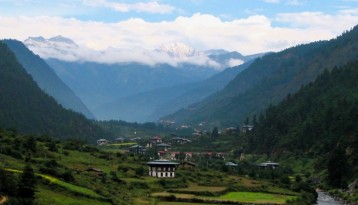
The Buddhist Kingdom of Bhutan lies along the lofty ridges of the eastern Himalayas, bordered by China (Tibet) to the north and northwest, and by the Indian states of Arunachal Pradesh, Assam, West Bengal and Sikkim on the east, south and west respectively. With an area of 46,500 square km Bhutan is comparable to Switzerland both in its size and topography.
It was the mighty Himalayas, which protected Bhutan from the rest of the world, and left the Kingdom blissfully untouched. Bhutanese people are driven by their respect for the tantric strain of Mahayana Buddhism.. The Bhutanese people have been able to protect this sacred heritage and unique identity for centuries by choosing to remain shrouded in a jealously guarded isolation.
The population of the kingdom is only about 600,000. Three main ethnic groups constitute Bhutan’s population; the Sharchops, who are held to be earliest residen
Day 1: Arrive in Paro
Day 2: At paro
Day 3: Paro / Thimpu
Day 4: Thimpu
Day 5: Thimpu / Phuntsholing
Day 6: Depart Phuntsholing
PRICE INCLUDES
PRICE EXCLUDES
* This tour can be fully customized as per your requirement.
Day 1: Arrive in Paro
On arrival transfer/check in assistance to the hotel. Visit the Paro market in the evening. Overnight in Paro.
Day 2: At paro
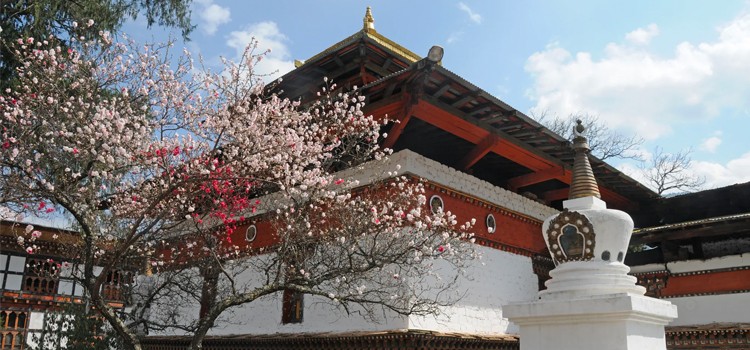
After breakfast full day sightseeing, visit to Kyichu Lhakhang, Drukgyel Dzong, traditional Farm House and later excursion to Taktsang Monastery or to Kila Gomba. Overnight in Paro.
Day 3: Paro / Thimpu
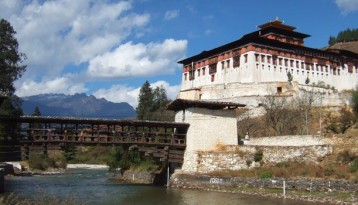
Morning sightseeing in Paro, visit to: Ta Dzong (National Museum), Rinpung Dzong. After lunch drive to Thimphu en route visit Simtokha Dzong. Visit the Thimpu market in the evening. Overnight in Thimphu.
Day 4: Thimpu
Today’s full day sightseeing in Thimphu includes, visit to: Memorial Chorten, Tashichhodzong, National Library, Painting School, Traditional Medicine Institute, Handicrafts Emporium, and Thimphu’s viewpoint. Overnight in Thimphu.
Day 5: Thimpu / Phuntsholing
After breakfast drive to Phuntsholing. Nearby Phuntsholing, visit Kamji Monastery & Kharbandi Gompa. Check into the hotel on arrival. Visit the Phuntsholing town and market in the evening. Overnight in Phuntsholing.
Day 6: Depart Phuntsholing
After breakfast depart from Phuntsholing for onward program. ** This itinerary can be further extended to visit Indian region of Darjeeling, Gangtok, Kalimpong.
Note : The given cost are per person and exclude international flights. Given below are the departure dates available for online booking. If the given date is not favorable then please contact us and we will happily customize your trip on dates more appropriate for you.
1. Where is Bhutan?
Bhutan is a land-locked country nestled between the world’s giants, India and the Tibetan region of China. Bhutan – Land of the Thunder Dragon is one of the most exotic destinations in the world today. This kingdom, often referred to as the last Shangri-la, is a land of outstanding people, remarkable scenery and natural wonders, and a proud and vibrant culture. Moreover, it is now gradually opening to the world with a sensitive approach to tourism.
2. What is the time difference in Bhutan?
Bhutan Standard Time ( IST ) is 0600 hours (6 hours) ahead of Greenwich Mean Time (GMT+6).
3. How can I enter Bhutan?
There are a number of airports where you can fly into Bhutan from. At present two carriers operate to Bhutan, Drukair and Bhutan Airlines.
By Air the Entry Points are:
Bangkok to Paro.
Dhaka to Paro.
Katmandu to Paro.
Kolkata to Paro.
Delhi to Paro.
Singapore to Paro.
By Land, the Entry Points are:
Also, there are three land border crossings which you can travel into the kingdom overland. All crossings are along the Indian border only - Phuentsholing, Gelephu and Samdrup Jongkhar.
Bagdora to Phuntsholing.
Bagdora to Gelephu.
Guwahati to Samdrup Jongkhar.
Note: Exit can also be done through the same Entry Points.
4. How can I process Visa?
All International tourists wishing to enter Bhutan require a visa which must be pre-arranged through a license Bhutanese Tour Operator or one of their international partners. Visa clearance must be obtained through your tour operator prior to travel. For Indian passport (or VIC) holders, Bangladeshi nationals and persons from the Maldives may obtain a visa on entry. Visas are approved by the Immigration Department in Thimphu, with which you allowed to enter Bhutan or board the Druk Air flight and Bhutan Airlines.
The actual visa is stamped on the passport upon arrival in the country, either at Paro airport or (if entering by road) at Phuentsholing. You just need to provide us a passport scanned copy by email which should be more than six months validity. There is no need to send the pictures or sign the visa application at this time.
5. What is Visa cost?
International tourist visas a cost of USD $50 applies with TDF (Tourism Development Fund). This can be paid in advance to you tour operator or travel agent. For Indian passport (or VIC) holders, Bangladeshi nationals and persons from the Maldives there is no cost incurred.
6. What is the best time to travel to Bhutan?
Bhutan is a year round Tourist Destination and every season or month is the best time. However, depending on climate and festivals, the season is defined either as High or Low seasons. Hence, the best time could be season time and good time can be low season time. However, if you are looking for low cost and good time, we consider the months of January, June and July as the Best time. During this time, you will see fewer foreigners in Bhutan and you have the luxury of enjoying your privacy. When it comes to Hotels also, you have more choices and you will also receive special attention both from the Hoteliers and your Agent since there won’t be many guests and it can be well taken care.
March – May and September – November is the best time to travel in Bhutan. The climate is good then and there are many festivals around this time.
7. Do I require a travel insurance?
Yes, Book Bhutan Tour is committed to a careful preparation of the tour, but cannot foresee all risks and contingencies. In view of these risks, participation is at your own risk. For your own safety of the traveler is to take out a luggage, accident, travel liability and travel insurance that covers the costs of repatriation in case of accident or illness, as a cancellation insurance is strongly recommended. These are not included in the tour price. In addition, Swiss nationals are recommended REGA patronage.
8. What currency shall I carry?
Bhutanese currency is known as the Ngultrum. Most currencies are exchanged by banks here. The most commonly accepted currencies are Ngultrum, US dollars and Indian rupees. However Indian notes in 500 and 1000 denominations are not acceptable. Most handicraft shops accept US dollar. You can even exchange the currencies in some local shops. They give you better exchange rate than the banks.
9. Is it safe to drink tap water in Bhutan?
Tap water is not considered safe for drinking and also ice cubes should be avoided. Mineral water is easily available throughout the country (but make sure that seal is not broken). At the same time it is better to go with the trusted brand rather than picking the local brands.
10. Do I have to worry about altitude sickness in Bhutan?
The altitude in Bhutan is higher than many people are habituated to. Although many people might not have any problem in adjusting, altitude sickness may be a problem for a few ones. If visitors do some simple preparations before leaving for Bhutan, most of the symptoms of altitude sickness can be avoided. Being healthy and in good shape before you arrive in Bhutan will help greatly. It is also recommended that you talk to your local doctor about AMS and medicines in case of emergency.
11. Are there ATM s counter in Bhutan?
Bank of Bhutan (BoB), Bhutan National Bank and Druk PNB Bank ATMs usually accept foreign credit cards; however, it would be prudent to get your cash in Thimphu or Paro before heading out into the countryside, particularly the far east. Transactions are limited to Nu 10,000 or Nu15,000.
12. Is the country safe to travel?
Absolutely, Bhutan is safe for traveler. There is little crime in Bhutan and it is safe for women, family with children and for solo travelers as well. However, women are advised to follow the same universal precautions when they are in crowded entertainment places at night, mainly when in discos or bars.
13. What is the electricity supply in Bhutan and what plugs are used?
240 volts AC – Flat round 2-pin plugs are most common and a universal adapter is an important travel item. Power cuts are quite frequent in central and eastern Bhutan while western Bhutan has stable power supply.
14. What is the electricity supply in Bhutan and what plugs are used?
240 volts AC – Flat round 2-pin plugs are most common and a universal adapter is an important travel item. Power cuts are quite frequent in central and eastern Bhutan while western Bhutan has stable power supply.
| Price : | USD Contact Us |
| Country : | Bhutan |
| Trip Start From : | Paro |
| Trip End In : | Paro |
| Max. Altitude : | |
| Group Size : | +2 |
| Best Seasons : | |
| Transportation : | Flight/Private Car or Tourist Van |
| Accomodation : | Standard hotels |
| Meals : | |
| Duration : | 6 Days |
© 2026 Tashi Delek Nepal Treks All Rights Reserved. Crafted by Dot Web Technologies