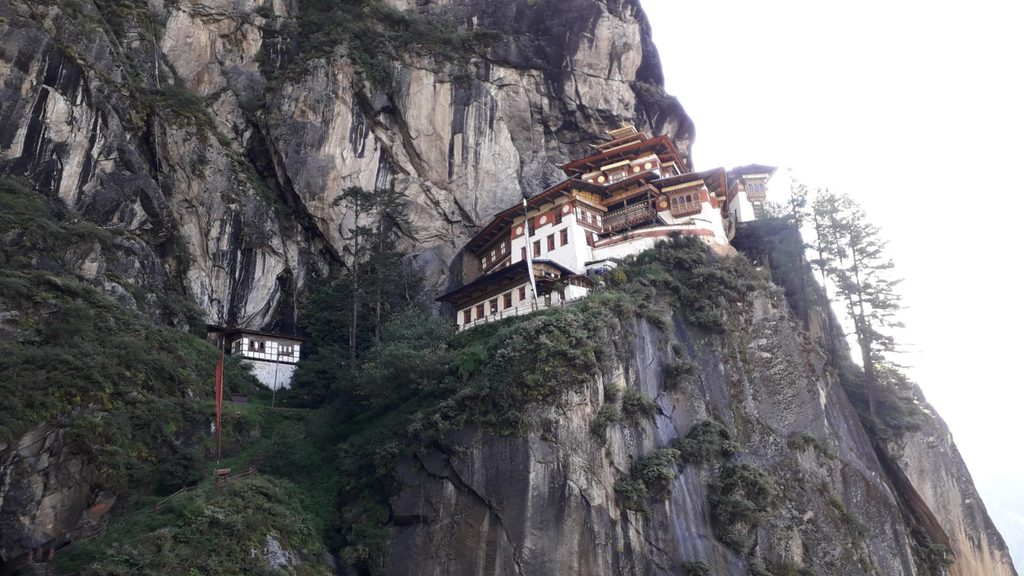
The Tiger’s Nest Monastery in Bhutan sits on a cliff at 3,120 meters, about 900 meters above the Paro valley. The hike is moderate. Most people need 5 to 6 hours for the whole trip, including the climb, the temple visit, and the walk back down. You don’t need any climbing experience, just steady legs and a slow, comfortable pace. Go in spring or autumn, start by about 8 am, wear proper shoes, and give yourself a few days in Bhutan before you try it. Horses can carry you halfway to the cafeteria, but the last part is on foot.
If you’re planning a Bhutan tour, the Tiger’s Nest hike is almost certainly on your list. It’s the picture on every postcard, and it’s the one thing most visitors say they’d do again. Here is what the hike is really like, so you can decide how to fit it into your trip.
What Is the Tiger’s Nest Monastery?
Tiger’s Nest is the English name for Paro Taktsang, a group of temples built into a sheer rock face above the Paro valley. In Bhutanese tradition, the saint Guru Rinpoche flew here on the back of a tigress and meditated in a cave, which is how the place got its name. It became one of the most sacred sites in the Himalayan Buddhist world.
A fire damaged the main buildings in 1998, and they were carefully rebuilt afterwards. Today it’s a working religious site, not a museum. That matters, because it shapes the rules you’ll follow when you visit (more on those below).
Tiger’s Nest Hike at a Glance
| Trailhead height | Around 2,600 m |
| Monastery height | 3,120 m, about 900 m above the Paro valley floor |
| Distance | Roughly 8 km round trip (sources vary between 6 and 9 km) |
| Time | 5 to 6 hours for most people, including the visit |
| Difficulty | Moderate |
| Halfway stop | Taktsang Cafeteria, around 2,950 m |
| Horses | Available to the cafeteria only |
How Hard Is the Tiger’s Nest Hike?
It’s moderate. The path is a wide dirt trail with some stone steps, nothing technical, and you won’t need ropes or special gear. What makes it tiring is the steady uphill and the altitude, not the terrain.
If you walk or hike regularly, you’ll be fine. If you mostly sit all day, you can still do it, just slowly. Plenty of first-time hikers, older travelers, and families do this walk. Your guide sets a gentle pace and stops whenever you need a break.
The part people find hardest is usually the final stretch. After the cafeteria the path goes down a long set of stone steps into the gorge, passes a waterfall, and then climbs back up another flight of steps to the monastery entrance. Your legs will notice it, especially on the way back.
How Long Does the Tiger’s Nest Hike Take?
Most people reach the cafeteria in 1 to 1.5 hours, and the monastery in about 2 to 3 hours of walking in total. Add time inside the temples, a rest, and the way down, and you’re looking at 5 to 6 hours. Fast, fit hikers can do it faster. Slower walkers, or people who stop for lots of photos, can take 7 hours. That’s fine. Nobody is timing you.
What Does the Trail Look Like?
Part 1: Trailhead to the cafeteria. You start in a pine forest with prayer flags hanging between the trees and a few prayer wheels along the path. This is the steepest and sweatiest part. Take it slowly.
Part 2: Cafeteria to the viewpoint. The Taktsang Cafeteria is a good place for tea and a rest, and the first proper view of the monastery is just beyond it. This section is gentler than the first.
Part 3: The steps to the monastery. Down into the gorge, past the waterfall, and up again to the entrance. Then you go inside with your guide, who explains what you’re looking at.
Can I Ride a Horse to Tiger’s Nest?
Yes, but only to the cafeteria. Horses wait at the trailhead and carry riders to the halfway point. From there you walk the rest. Local people say that if you ride a horse up, you share the merit of the pilgrimage with it, which is a nice thing to know when you’re deciding.
If you plan to ride, tell your guide in advance. The horse fee isn’t included in most tour prices, so you pay for it separately.
What Is the Best Time of Year to Hike Tiger’s Nest?
Spring (March to May) is lovely. The valley is green, flowers are out, and the Paro Tshechu festival often falls in this season.
Autumn (September to November) gives you the clearest skies and the best mountain views.
Winter (December to February) is cold but usually sunny, and there are fewer people on the trail.
Monsoon (June to August) is the hardest time. The trail can be slippery, and clouds often hide the monastery. It’s still possible, just bring a good rain jacket and shoes with grip.
What Is the Best Time of Day to Start?
Early. Aim to be on the trail by around 8 am. The air is cooler, the trail is quieter, and the views are clearer before clouds roll in. An early start also leaves you time to rest at the cafeteria and visit the temples without rushing. The temples usually close for a lunch break, so your guide will plan around that.
What Should I Wear and Bring?
- Sturdy walking shoes or light hiking boots with good grip
- Layers, since it’s cool in the shade and warm in the sun
- A light rain jacket
- At least a liter of water and a few snacks
- Sunscreen, sunglasses, and a hat
- A little cash for the cafeteria
- A small daypack (you’ll leave it in a locker before entering the temples)
- Trekking poles if your knees complain on stairs. You can also rent a walking stick at the base.
For the temples, wear modest clothes that cover your shoulders and knees.
Rules to Know Before You Go
Tiger’s Nest is a sacred place, and a few rules apply:
- Phones, cameras, and bags are normally not allowed inside the temples. You leave them in lockers at the entrance, so ask your guide how it works that day.
- Photos are fine along the trail and at the viewpoint, just not inside.
- Take off your shoes before entering a temple room, and speak quietly.
- Walk clockwise around shrines and prayer wheels.
- You travel with a licensed guide in Bhutan, so you won’t be doing this alone. Your guide handles tickets and explains what you see.
Tips From Guides Who Do This Walk Often
- Don’t do it on your arrival day. Paro sits at about 2,250 meters. Give yourself a day or two first.
- Go slowly. A steady, slow pace uses less energy than speeding up and stopping.
- Treat the cafeteria as a checkpoint. If you feel good, carry on. If you’re tired, rest there and decide.
- Save energy for the stairs. The last section is where most people feel it.
- Drink water, even if it’s cool. Altitude dries you out faster than you notice.
- Check with your doctor first if you have heart, lung, or knee problems.
If you’re a woman traveling alone, our guide to solo female travel in Bhutan covers safety, guides, and what to expect. And if one day on the trail isn’t enough, our Bhutan Trekking Guide walks you through the Druk Path, Jomolhari, and Snowman treks.
How Does Tiger’s Nest Fit Into a Bhutan Tour?
On our 4 Nights 5 Days Bhutan Tour, the Tiger’s Nest hike happens on day four in Paro, after you’ve visited Thimphu and Punakha. You also see Kyichu Lhakhang and Rinpung Dzong in Paro that day. The package covers a licensed English-speaking guide, private transport, hotel stays with all meals, entrance fees, and the Sustainable Development Fee. Visa fees, flights, insurance, tips, and horse rides are extra.
Prices for this Bhutan tour package start from USD 1,280 per person for a solo traveler. The per-person price drops to USD 960 for two people, USD 920 for groups of 3 to 8, and USD 880 for groups of 9 to 12. The trip can also be customized.
If you want more days, see our 6 Nights 7 Days Bhutan Tour and Central Bhutan Tour, or browse all of our Bhutan tour packages. Ask us to confirm the Tiger’s Nest hike is on your itinerary when you inquire.
Frequently Asked Questions
Is the Tiger’s Nest hike hard? It’s moderate. The trail is a steady uphill on dirt paths and stone steps with no climbing. Most reasonably active people manage it at an easy pace.
How long does the Tiger’s Nest hike take? Plan on 5 to 6 hours for the full trip, including the climb, the temple visit, and the walk down. Some people finish faster and some take up to 7 hours.
How far is the Tiger’s Nest hike? Roughly 8 km round trip. Different sources give figures between 6 and 9 km, depending on which route and starting point they measure.
How high is Tiger’s Nest Monastery? The monastery is at 3,120 meters, about 900 meters above the Paro valley. The hike starts at roughly 2,600 meters.
Can you ride a horse to Tiger’s Nest? Yes, to the Taktsang Cafeteria at the halfway point. The rest of the way is on foot.
Can you go inside Tiger’s Nest? Yes, with your guide. Phones, cameras, and bags are left in lockers at the entrance, and photos aren’t allowed inside.
Do I need a guide for the Tiger’s Nest hike? Yes. Travelers in Bhutan go with a licensed guide, who handles entry and explains the temples.
Is there an entrance ticket for Tiger’s Nest? If you travel on a package, entrance fees are included in the itinerary. Horse rides are paid separately.
When is the best time to visit Tiger’s Nest Monastery? March to May and September to November are the most popular months. Start by about 8 am for cooler air and clearer views.
Can kids and older travelers do the Tiger’s Nest hike? Many do. Go slowly, use the cafeteria as a rest point, and consider a horse for the first half. Check with a doctor first if there are any health concerns.
Do I need to worry about altitude sickness at Tiger’s Nest? The monastery is at 3,120 meters, so mild altitude effects are possible for some people. Spend a day or two in Bhutan first, drink plenty of water, and go slowly.
How many days do I need in Bhutan to do Tiger’s Nest? You can fit it into a short trip. Our 4 Nights 5 Days Bhutan Tour includes it, though most people enjoy a few extra days to see more of the country.
Planning a Bhutan Tour With Tiger’s Nest?
If you’re deciding how many days you need, which season to pick, or whether the hike suits your family, we can help. Send us an inquiry with your travel dates, group size, and how active you’d like the trip to be, and we’ll put together a Bhutan tour that includes the Tiger’s Nest hike at a pace that works for you.